
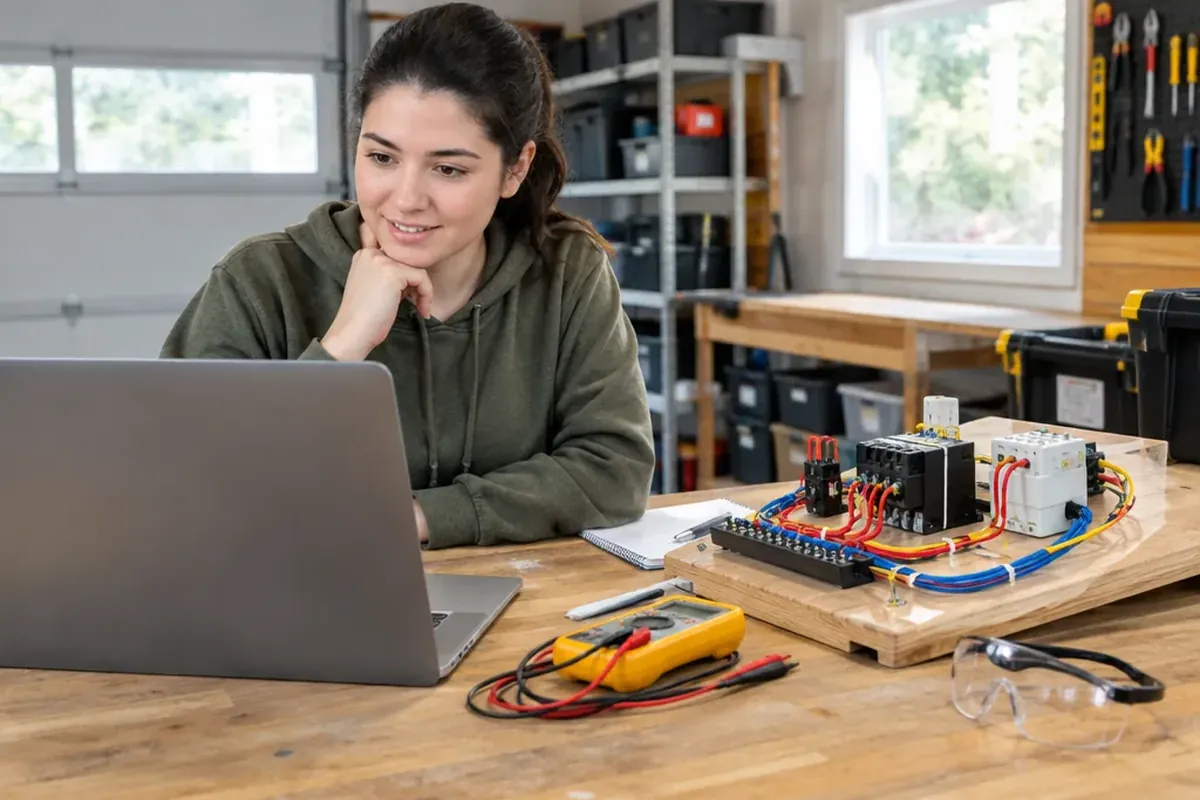
An online trade school can teach you the theory, terminology, safety rules, and troubleshooting behind a new career without requiring you to sit in a classroom every day. The important distinction is the job itself: IT support and medical billing can be fully online, while an electrician, HVAC technician, welder, or plumber still needs supervised practice with equipment and, in many cases, field hours for licensing.
Trade school classes turn a job title into practical skills
A vocational or trade course focuses on a specific occupation and can lead to a certificate, diploma, or associate degree. Most trade programs take one to two years, compared with four or more years for a bachelor’s degree. Associate degree programs also include general education courses such as math, English, and science.
The technical coursework changes sharply by field. An HVAC student may study electrical fundamentals, safety codes, troubleshooting, and preparation for EPA 608 refrigerant handling. Electrician training can cover electrical theory, National Electrical Code study, blueprint reading, wiring methods, and conduit bending. Welding coursework covers theory, safety, materials science, and MIG, TIG, and Stick techniques.
| Career direction | What you can study online | What may require in-person work |
|---|---|---|
| HVAC technician | Electrical fundamentals, safety codes, troubleshooting, EPA 608 preparation | Labs and equipment practice |
| Electrician | Theory, NEC study, blueprints, wiring methods | Conduit work and supervised field experience |
| Welder | Theory, safety, materials science | MIG, TIG, and Stick practice |
| Medical billing and coding | ICD-10/CPT systems, billing software, terminology, claims | Often no lab requirement |
| IT support | CompTIA A+ preparation, networking, cybersecurity basics, operating systems | Program-dependent practical work |
Which trades can you learn online, and which need a lab?
Some career training programs can be completed fully online: IT support, medical billing and coding, paralegal studies, business administration, accounting, and construction management. These paths rely on software, documents, systems, and case-based work that can be taught at a distance.
Physical skilled trade programs are usually hybrid. HVAC, electrical, welding, plumbing, automotive, and solar installation commonly put theory online and reserve labs for campus or local sessions. That arrangement is not a drawback to hide; it is how you practice safely with tools and demonstrate essential skills. A program that teaches electrical theory online may help you prepare for a credential exam, but it does not make you a licensed contractor without required field hours.
How to tell whether an online trade school is legitimate
Legitimate online trade schools hold accreditation from agencies recognized by the U.S. Department of Education. Relevant accreditors include the Accrediting Commission of Career Schools and Colleges (ACCSC), ACCET, COE, and the Distance Education Accrediting Commission (DEAC). ACCSC accredits more than 650 schools and 150,000 students.
Before enrolling, verify the school’s accreditor in the Department of Education’s recognized-agency database. Then ask a question that a brochure cannot answer vaguely: where exactly will labs, practical testing, clinical work, and hands-on training happen? Legitimate online programs should clearly disclose how and where required in-person training is completed. Unaccredited study may not be accepted by employers and may not qualify for federal aid.
Compare costs and financial aid before you choose a program
Tuition varies by program and school type. Short certificates can start at $3,900, while specialized programs can reach $30,000; a typical trade school total is around $15,000 in tuition and fees. Books and tools add about $1,700 on average, with a reported range of $850 to $2,500.
| Cost reference | Reported amount | Basis |
|---|---|---|
| Public community college | $8,730 per year | Trade-school cost comparison |
| Private nonprofit college | $19,300 per year | Trade-school cost comparison |
| Private for-profit college | $16,050 per year | Trade-school cost comparison |
| Electrician program | $14,600–$16,000 | Trade-specific cost comparison |
| HVAC program | $10,000–$15,000 | Trade-specific cost comparison |
Students at accredited trade schools can use the FAFSA to apply for federal aid. For the 2025–26 school year, Pell Grants can be worth up to $7,395. Starting in July 2026, Workforce Pell Grants expand eligibility to short-term programs as short as eight weeks. Compare aid options, including scholarships and 529 funds for programs that meet credentialing standards, before judging a program by its posted price.
Choose training that matches your state and your work schedule
- Confirm accreditation and check whether the program meets licensing requirements in your state, especially for electrical, plumbing, and HVAC work.
- Identify the format: fully online, hybrid, or a program that combines online theory with an apprenticeship path.
- Test the learning platform for video instruction, virtual labs, chat rooms, and instructor access.
- Ask about career services, employer partnerships, job placement assistance, and apprenticeship connections.
- Compare retention and graduation rates, and weigh public nonprofit options such as community colleges against for-profit schools.
For example, Stark State College offers online workforce trade programs, including self-paced electrical technician training with more than 160 course hours. Its overall catalog includes more than 200 associate degree, bachelor’s degree, certificate, and credential programs. Online offerings listed for the college include Accounting Technician, Business Support Services, Computer Engineering Technician, and Drafting and Design.
Match your training choice to the job you want next
There is no universally easiest trade that pays well. The right choice depends on your physical abilities and technical skills. Medical billing and coding can take four to 12 months, can be fully online, and has a reported 2025 median salary of $51,140. HVAC training often takes six to 12 months and HVAC technicians have a reported median pay of $61,010.
For jobs that require field experience, trade school is often the first stage rather than the finish line. Electricians, plumbers, and many construction workers typically complete apprenticeships that combine paid on-the-job training with classroom instruction. HVAC apprenticeships typically run three to five years; online theory can support a pre-apprenticeship route but cannot replace supervised hours.
Several trade careers pair training with substantial projected demand. Electricians had a reported median pay of $63,190 in May 2025 and about 72,700 annual openings projected for 2025–35. Industrial maintenance mechanics had a $64,520 median and about 54,200 annual openings. A maintenance technician role may reward the same troubleshooting skills that an online program introduces, but employers and licensing rules determine the next required step.
Don’t let these online trade school myths steer your decision
Myth: Every trade can be learned completely online
Online instruction can cover theory, code, safety, and exam preparation. It cannot substitute for the in-person labs and field hours normally required for HVAC, welding, plumbing, and electrical work.
Myth: A short program automatically leads to a license
A diploma or certificate can document career training and prepare you for a certification exam, but state licensing boards may require supervised experience. Check your state’s requirements before choosing a residential electrician or service technician course.
Myth: Lowest tuition means lowest total cost
Tuition is only one line in the budget. Tools and books can add $850 to $2,500, and the availability of financial aid can change what you pay.
Frequently Asked Questions
What classes are in trade school?
Classes combine job-specific theory with safety and troubleshooting. Examples include HVAC electrical fundamentals and EPA 608 preparation, electrician code and blueprint study, welding theory, and medical coding systems. Associate degrees add general education courses.
What online degrees are offered at Stark State College?
Stark State lists online options including Accounting Technician, Business Support Services, Computer Engineering Technician, and Drafting and Design. Its workforce portal also includes self-paced electrical technician training and its online pharmacy technician program prepares students for the Pharmacy Technician Certification Board exam.
Are online trade schools legitimate and accredited?
They can be. Look for accreditation recognized by the U.S. Department of Education, such as accreditation from DEAC or ACCSC, and verify it in the Department’s database. Also get a clear explanation of every in-person requirement.
Can you learn a trade completely online?
IT support, billing and coding, paralegal studies, and several business-focused programs can be fully online. Trades that depend on tools and physical technique usually use a hybrid format with in-person labs.
How much does online trade school cost, and is financial aid available?
Reported program costs range from $3,900 for short certificates to $30,000 for specialized training. Accredited schools may offer federal aid; Pell Grants can reach $7,395 for the 2025–26 school year.